Infill Capital Partners · Lume Hotels · August 2026
LUME 86 BROAD
A 104-pod capsule hotel beneath the H.L. Green Building
86 Broad St SW · South Downtown Atlanta · ≈11,000 sq ft lower level (to be confirmed by survey) · prepared for SoDo Atlanta / Atlanta Ventures, with Bridger Properties
Private & confidential — indicative, desktop, pre-survey · please do not circulate beyond the SoDo Atlanta and Bridger teams
The thesis
Broad Street needs feet. A hotel is a machine that makes them nightly.
Three facts carry this deal — everything else is execution.
$0
TODAY
The lower level of the H.L. Green Building is drawn as "future use" in the current core-and-shell set — served, sprinklered, stubbed for tenant plumbing, and earning nothing while it waits.
≈85
GUESTS ON BROAD STREET, EVERY NIGHT (MODELLED)
104 pods — 80 singles, 24 doubles — at 74% modelled occupancy put ≈75–95 people a night on the block, eating, buying coffee, filling the square. Programming that pays rent, at the base of the district's flagship block.
First
IN THE SOUTHEAST
No capsule hotel operates in Atlanta; downtown hostel supply is effectively nil and the metro pipeline is 75% upper-midscale and above. The $40–90 quality tier is an empty band on the price map.
Lume converts the basement into the Southeast's first premium capsule hotel — L-stack singles and doubles, funded by ICP, operated on the Lume playbook, delivered on the landlord's whitebox — with more formats rolling to upper floors as the project proves itself.
The operator: Lume Hotels — the ICP capsule platform: Lume Shoreditch, London (70 pods, opening very soon; rooftop trading since April 2026) · Largo Richini, Milan (58 beds, in fit-out procurement) · Paris & Munich in negotiation. Atlanta — Hadi's home base — is the US beachhead.
The building
H.L. Green — the five-and-dime, reborn at the center of Broad Street
- The name: H.L. Green ran one of America's great five-and-dime chains — 200+ stores at its peak — and this building, running the block from Broad Street through to Peachtree St SW, has long carried the name. Affordable retail for everyone is the heritage; an affordable hotel tier extends the spirit of it.
- The renovation: core-and-shell under way (ASD|SKY set, latest revision Feb 2026) — new slab, relocated fire riser, fire-rated steel treatment, elevator works, tenant stub-ups and floor drains already drawn at the lower level.
- Upstairs: the ownership's published 2024 plan (davidcummings.org) slates the building for ATV Green — a second Atlanta Tech Village presence — anchoring a planned town square at the heart of historic Broad Street. We defer to your current plan for the upper floors; the thesis works with any office program above us.
- Our space: the lower level — clear-span structural bays (~19 ft), four exit stairs, two elevator cores, grease-trap bank and building electrical already in place.
What the owner gets
A floor with no natural retail use becomes the district's overnight population: base rent from day one, a share of operating profit as it grows, and the foot traffic every other tenant on the street is waiting for. Landlord capex stops at the whitebox already in the drawings — any hotel-specific scope the code review adds beyond that set is ICP's cost to price and carry.
$249K/yr
MODELLED LANDLORD INCOME AT BASE CASE — $409K AT THE UPSIDE GRID CELL
Brought together by Shelbi Bodner, Partner & SVP Retail at Bridger Properties — who connected the space, the ownership and Lume, and steers the process for all sides.
The district
South Downtown — a founder-built district that needs an overnight engine
By the public record — Rough Draft Atlanta (Aug 2026), atlantatech.news, davidcummings.org. You know these numbers better than we do; we'd rather be corrected than wrong.
- The bet: David Cummings and Jon Birdsong (SoDo Atlanta / Atlanta Ventures) hold ≈56 buildings and 11 parking lots across ~16 acres — ≈$140M committed to date of personal, patient capital on a 40–50 year "startup district" horizon.
- Already open: Founders Green (May 2026) · Spiller Park Coffee · Smorgasburg weekend market · a dozen restaurants and shops along Mitchell and Broad · ATV Sylvan (Jan 2025) by the stadium · AdPipe and Dr. Noze Best HQs on 10–20 year leases.
- The gap, in the owners' own words: Broad Street's commercial units are still mostly waiting for tenants, and (per Jon Birdsong, Aug 2026 press) the district now needs programming — "you don't turn the light switch on and everybody comes."
- The proof of demand: 40,000+ visitors came through South Downtown in June–July 2026 during the eight Atlanta World Cup matches (per the owners, in press). The crowds exist; tonight they sleep somewhere else.
A hotel is programming that pays rent
Restaurants and retail follow foot traffic; foot traffic follows people who are already there. A capsule hotel is the one use that delivers an overnight population without competing with a single existing tenant — guests arrive with an empty stomach, no coffee, and a free evening, two floors below a startup campus whose visitors need exactly this bed. It's the demand base the street's retail underwrites against.
Location & demand
One block from every train Atlanta runs
1 block
FIVE POINTS MARTA
Every rail line in the system meets here — mid-$230M rebuild into a mass-timber landmark (target 2029)
~18 min
ATL AIRPORT — DIRECT
One seat, no transfer, from the world's busiest airport to our block
51K+
GSU STUDENTS (SYSTEM)
Georgia State's flagship downtown campus is blocks away — record graduate enrollment in 2025
8
WORLD CUP MATCHES
Mercedes-Benz Stadium & State Farm Arena walkable — the Jun–Jul 2026 semifinal run showed the event ceiling
The Lume catchment test: airport rail link · dense weekday demand base · underserved sub-$100 quality tier · venue-scale floorplates at basement rents. 86 Broad passes all four — the same screen that selected 262 Old Street and 121 Holborn.
Honest print: Five Points station is a construction site until ≈2029. Guests route via Peachtree Center / Garnett today — and the finished station becomes our front door the year the programme matures.
The market
An empty band on the price map
Nothing below, downtown
Atlanta's hostel supply is a handful of houses far from downtown; no capsule product exists in the market. The budget guest's real alternative is a highway motel and a rideshare.
Everything above $150
Metro RevPAR growth is ADR-driven, and the 7,000+ room pipeline skews overwhelmingly upper-midscale and above (per HVS's supply study). Downtown compact rooms cluster $150–250 on event nights — and multiply on the big ones.
The $40–90 band is open
Private, secure, design-led sleep at $55–109 — above the hostel dorm on privacy, below every branded room on price. The closest US analogues (compact-room brands like citizenM and YOTEL) enter at roughly twice our price point; the capsule tier itself has no US downtown incumbent — that absence is the opportunity, and why we benchmark to the operators who proved it abroad.
THE PRICE LADDER, DOWNTOWN ATLANTA (INDICATIVE)
| PRODUCT | TYPICAL NIGHT | PRIVACY |
|---|
| Hostel dorm bed (limited supply, not downtown) | $35–60 | None — shared room |
| Lume L-stack capsule — single / double | $55–109 | Full — private locking pod |
| Budget/midscale branded room, downtown | $150+ | Full room |
The lineage
A 47-year-old format, proven on three continents
OSAKA · 1979
The original
Capsule Inn Osaka, by Metabolist architect Kisho Kurokawa — a bed, a screen and privacy for the salaryman who missed the last train. The use case never went away; the design finally caught up.
JAPAN · 2009→
The premium turn
Nine Hours and The Millennials rebuilt the capsule as design product — architect-led, gender-zoned, wellness-framed — and moved the price from survival to preference.
ASIA & EUROPE · 2015→
The operators
Bobobox (Indonesia): 37 properties, ~82% pod occupancy (2023, company-reported), backed by Li Ka-shing's Horizons Ventures. CityHub (Amsterdam): app-first hubs since 2015, ~50% direct bookings on Mews — the staffing-light playbook we run.
LONDON · 2020→
The scale proof
Zedwell put ≈1,000 windowless "cocoon" capsules into Piccadilly Circus — including lower floors — from £30/night. Basement levels are the format's natural habitat: quiet, dark, dense.
What the US attempts taught us
PodShare structured itself as membership co-living rather than a licensed hotel; Nap York closed and Sleepbox's US footprint shrank. The lessons are structural, and we price them in: enter as a properly licensed hotel, engineer life-safety first, buy the pods at factory cost, and run agentic staffing leverage from day one. The US gap isn't demand — it's execution discipline.
The guests
Six guests, one bed they can't find today
The event one-nighter
Doors at 8, encore at 11, flight at 9am. Tonight's stadium show ends a 10-minute walk from a $65 pod instead of a $250 room or a 40-minute drive home.
The GSU family
Move-in, orientation, graduation: the visiting families of a 50,000-student university system whose flagship campus is blocks away — price-sensitive, multi-night, booked on a calendar we can read.
The budget business traveler
In at 7pm, gone by 8am — needs clean, secure, central and $70, not a minibar. The tier Atlanta's pipeline stopped building.
The founder upstairs
The startup district's visiting founders, mentors and out-of-town hires — its guest room, two floors down from the planned tech-village floors. CityHub built a brand on exactly this guest.
The airport connector
One train, no transfer, from the world's busiest airport. Misconnects, dawn departures, crew-style overnights — the 1979 use case, on MARTA instead of the Midosuji line.
The group block
Teams, choirs, cohorts, hackathons: many single beds under one roof, cheaply — the booking hostels serve badly and hotels price out. Doubles give chaperones and couples their own door.
The experience
Arrival to lights-out
The Lume design language — calm, warm, tech-enabled — carried beneath Broad Street
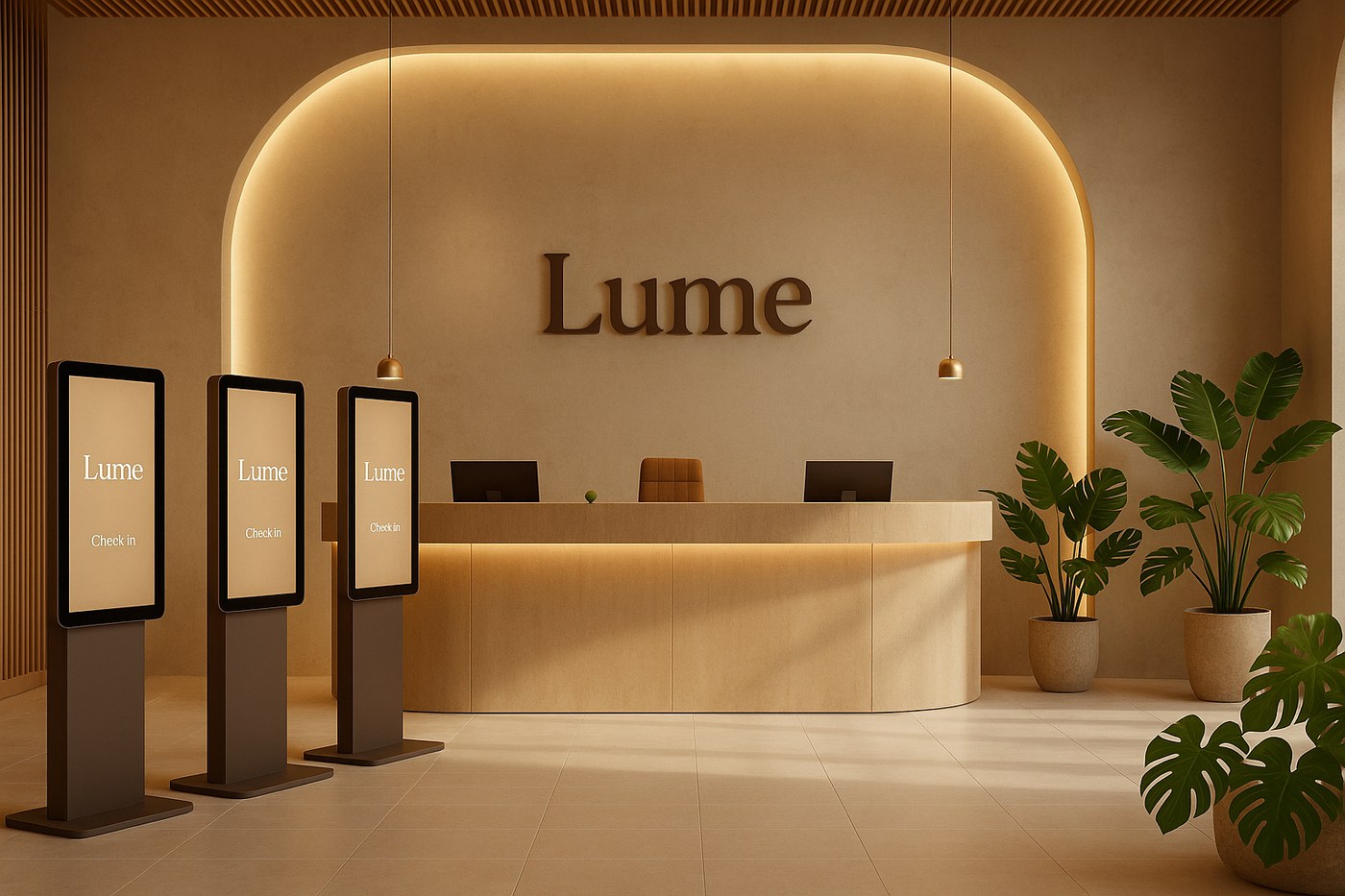
Arrival — Lume reception, self check-in kiosks and café (brand CGI, indicative)

The lounge library — co-work by day, quiet by night (brand CGI, indicative)
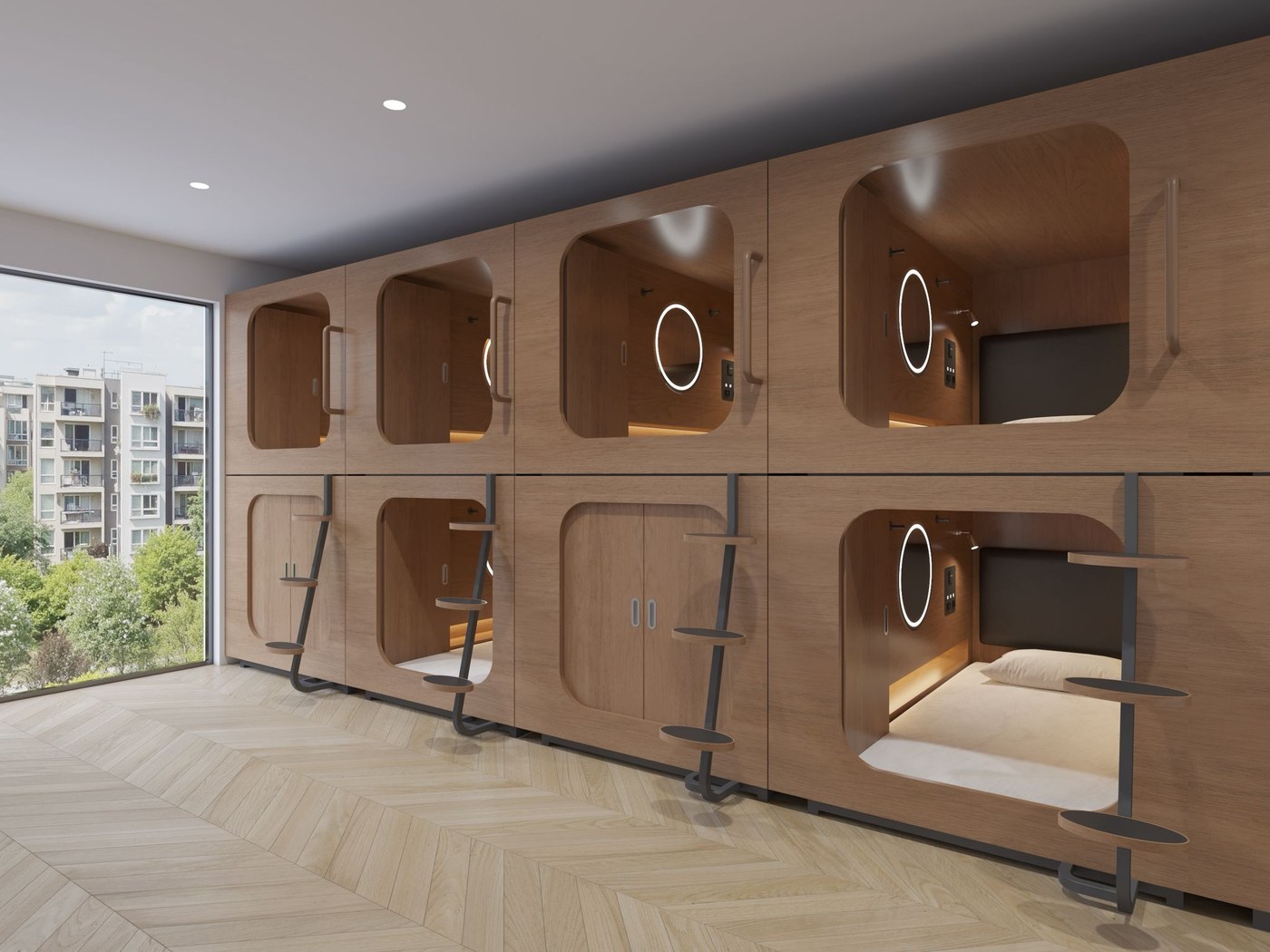
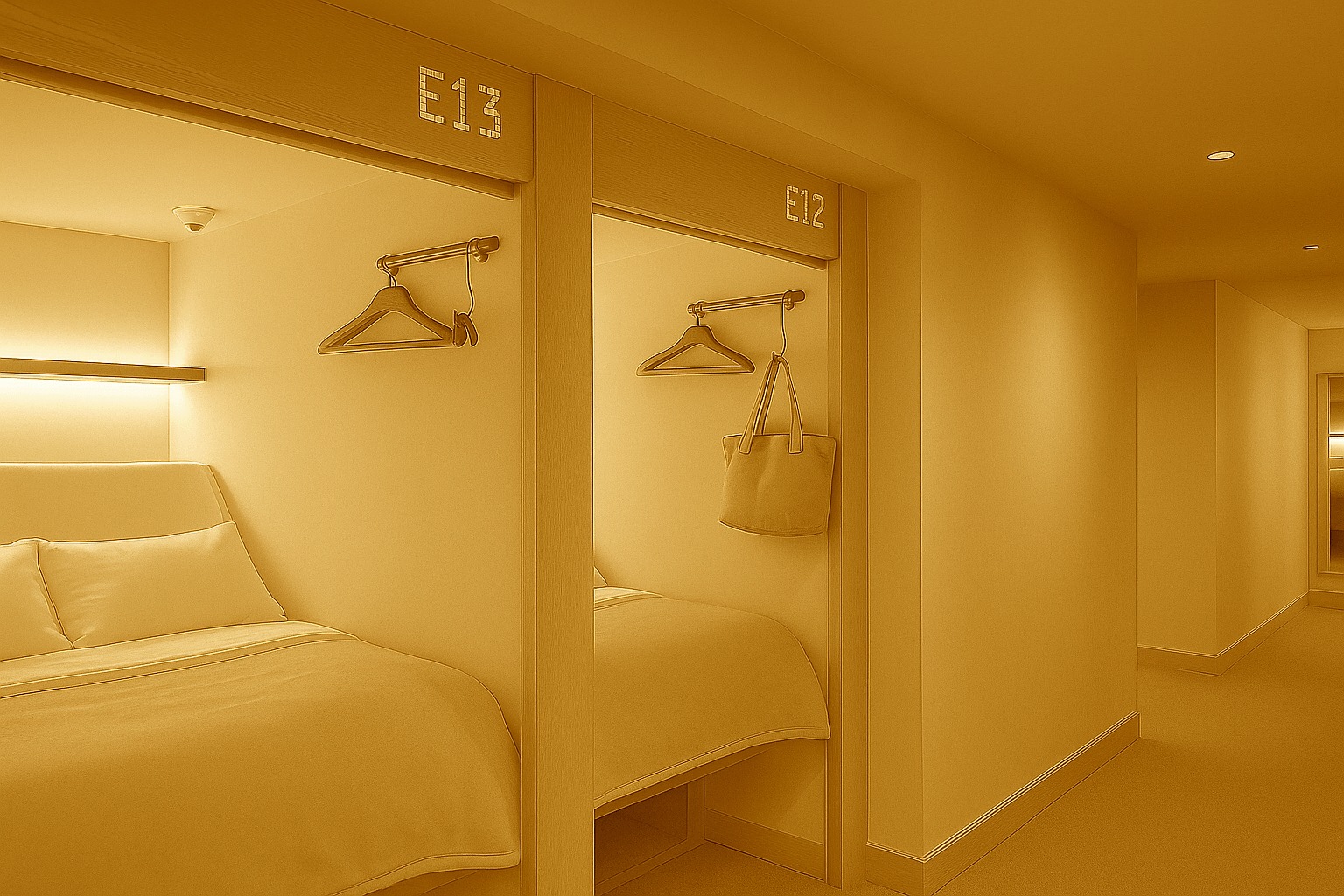
The pod hall — L-stacks in the library arrangement
The product
The L-stack, up close — singles and doubles first
A library of private sleep, not a dorm · Phase 1 ships the two formats the market proves everywhere: the single, and the double that upsells it
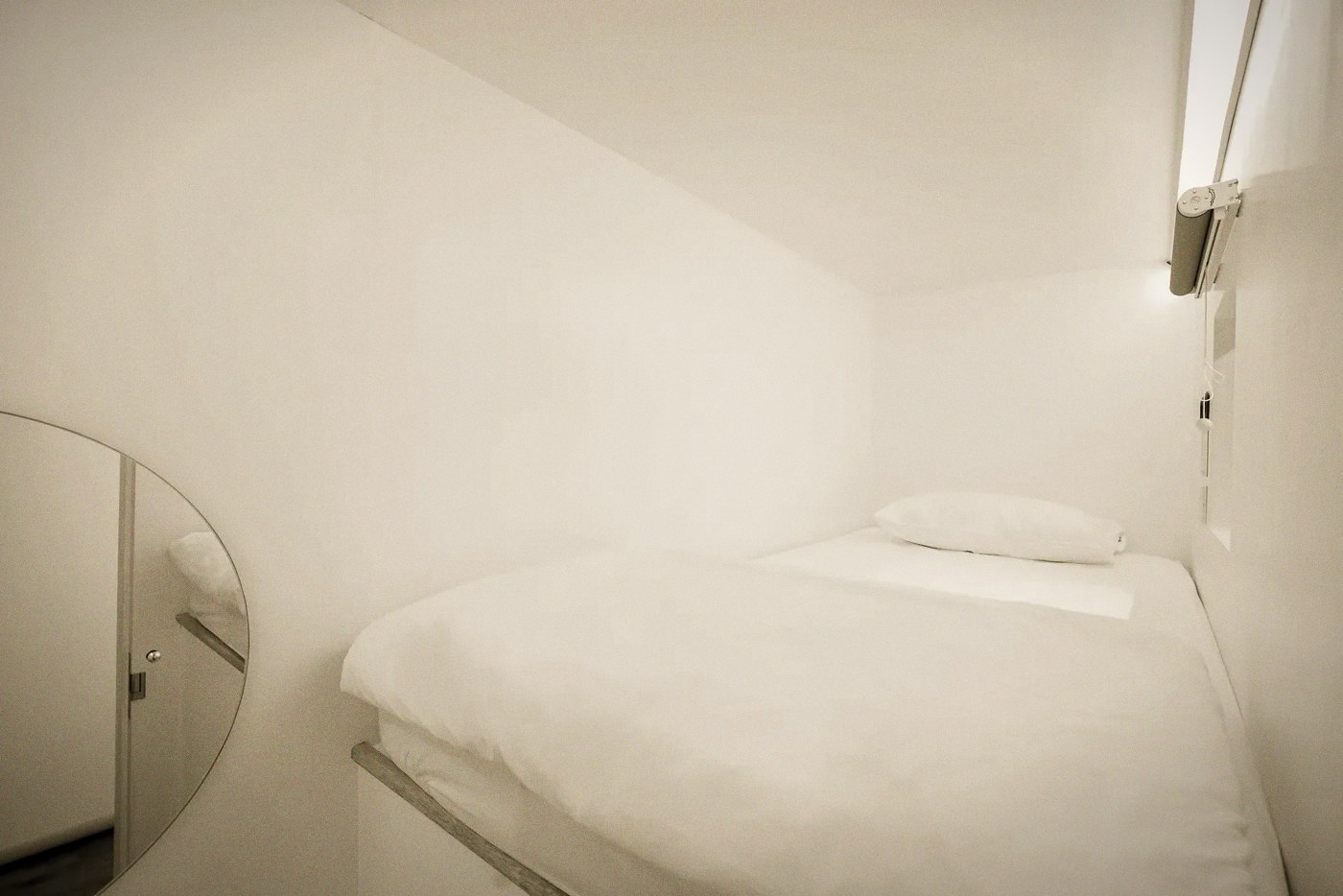
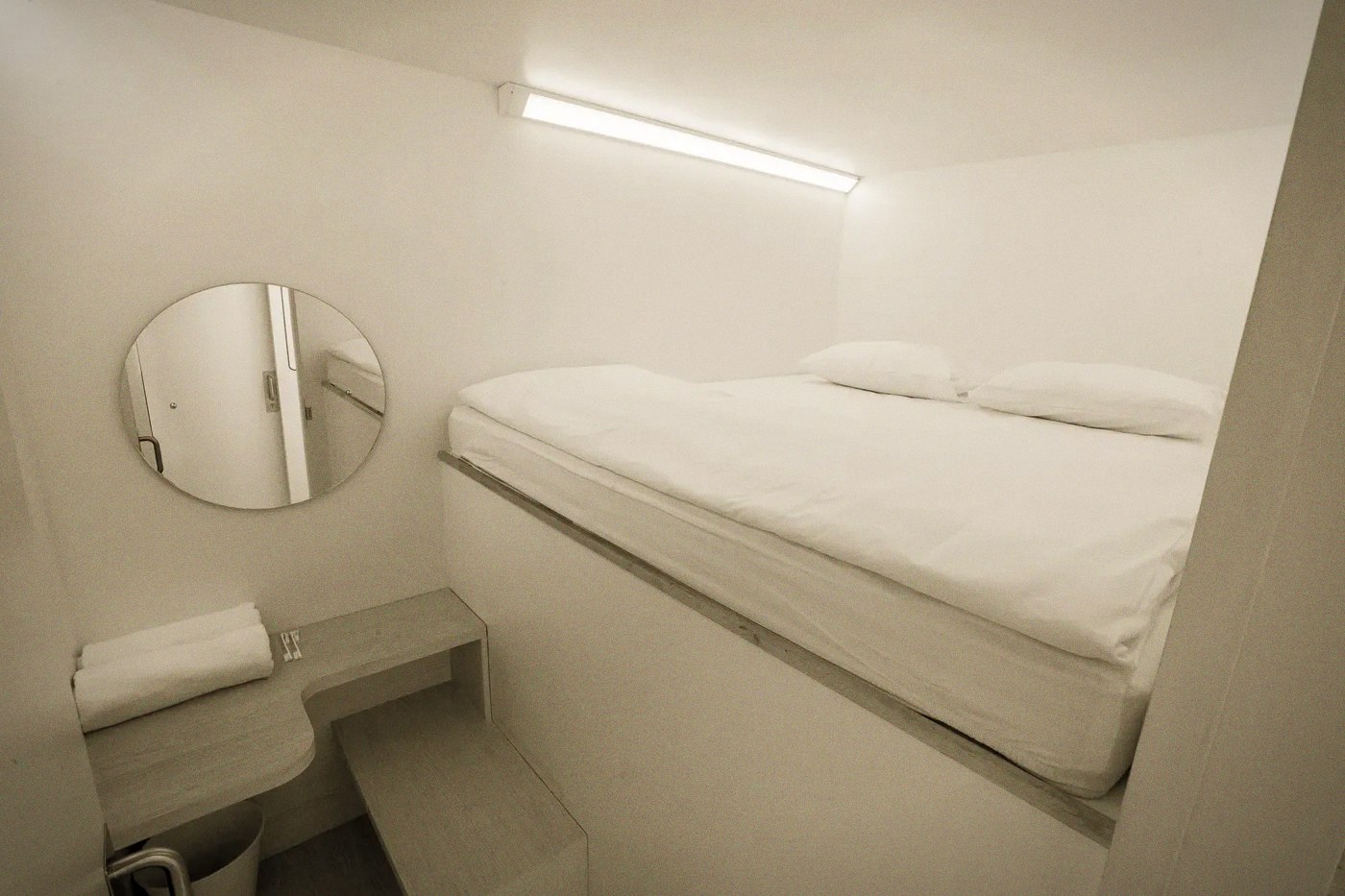
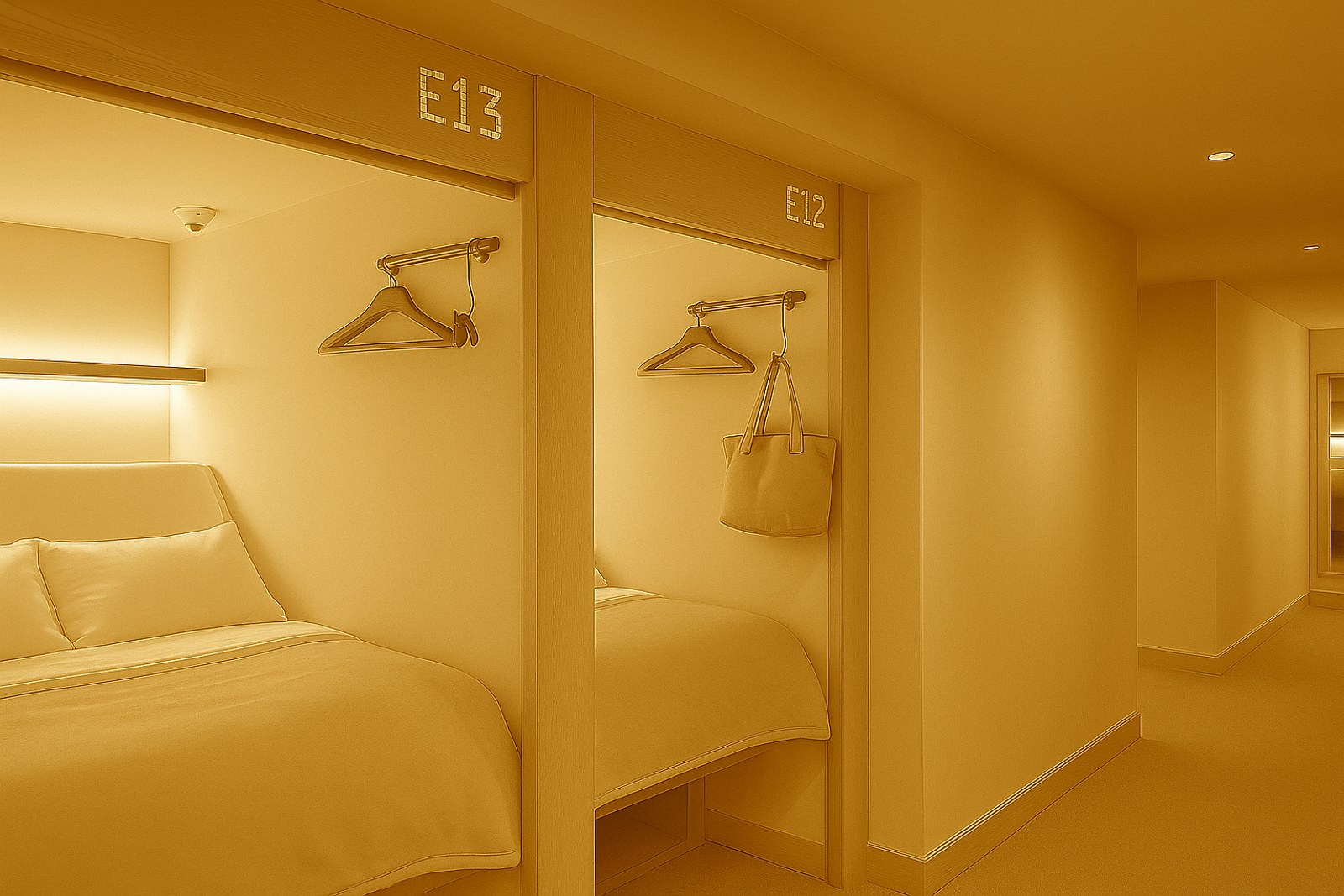
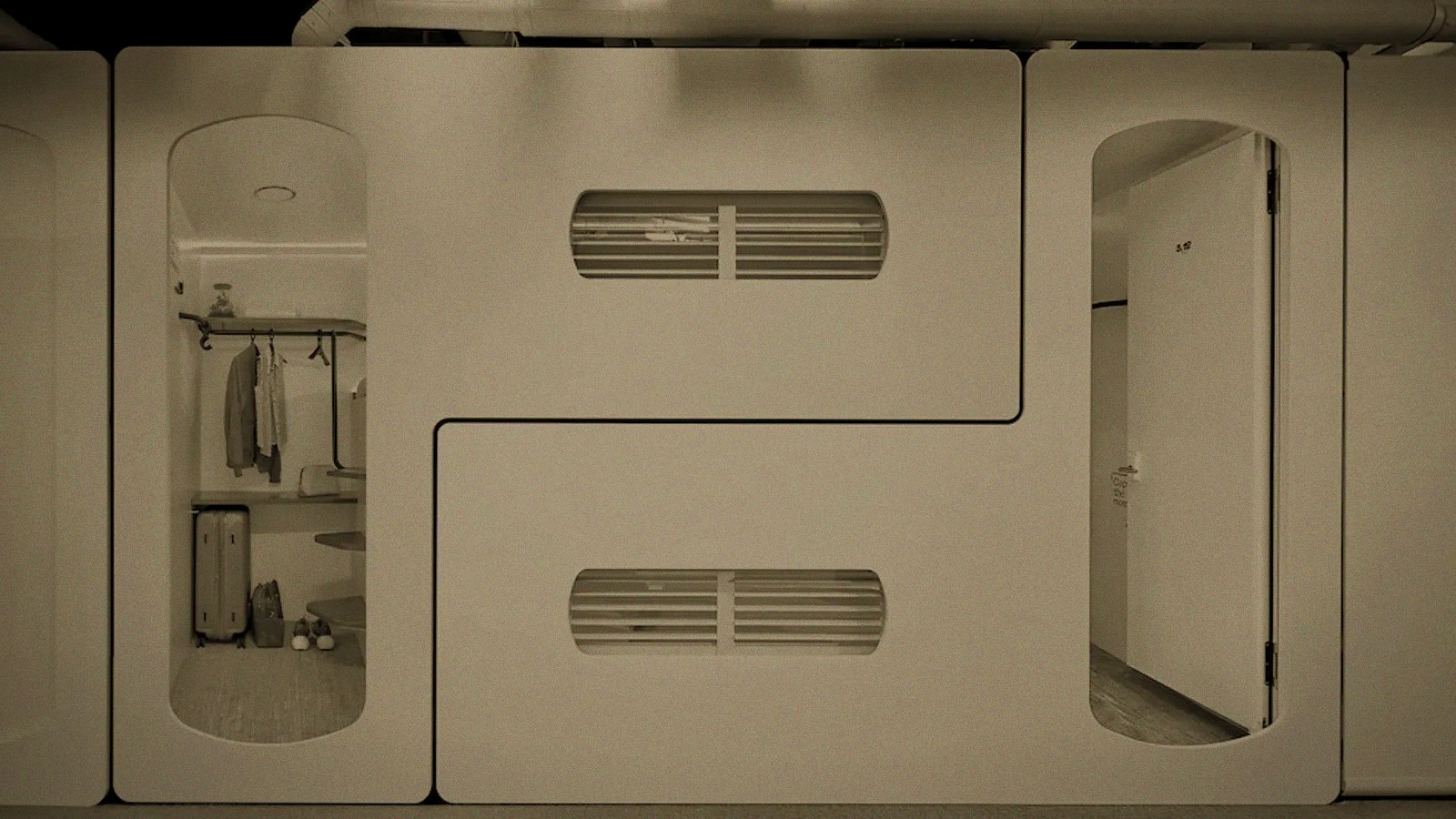
Left to right: the capsule, revealed · the pod hall · single and double formats (indicative format imagery)
Premium pods — engineered for sound comfort
Sound-dampened shells, personal lighting, airflow and power in every unit; secure locking access. Free-standing installation on the new slab — no structural work, no corridors of drywall, fully demountable at lease end.
Rate card
Two formats now — the ladder grows with the building
Affordable luxury in the open $40–90 band: every guest has an upsell in reach, and every event weekend re-prices the whole floor
| TIER · PHASE 1 | PODS | SUN–THU | FRI–SAT | MODELLED ADR |
|---|
| L-stack single (incl. step-free units) | 80 | $55 | $75 | $62 |
| L-stack double — full-size mattress, two guests | 24 | $85 | $109 | $92 |
| Blended (model) | 104 | | | ≈$69 + 8% ancillary |
Modelled ADRs sit slightly above the simple day-weighted average of the posted rates ($61 / $92) to reflect event-night dynamic pricing — the assumption is shown so it can be challenged.
EVENT NIGHTS
Stadium and arena calendars feed the dynamic pricing engine — the floor re-prices itself for the 8pm show and the 8am flight alike.
DAY SESSIONS · LATER
Airport-connector day-rest sessions are a proven second sale of the same pod — reserved for Phase 2 once the overnight base is trading.
PHASE 2 TIERS
Wellness cabins, family quads and recliner formats roll to upper floors as trading proves — the Holborn and Shoreditch tier system, imported when the building is ready.
The plan
A floor already engineered for this use
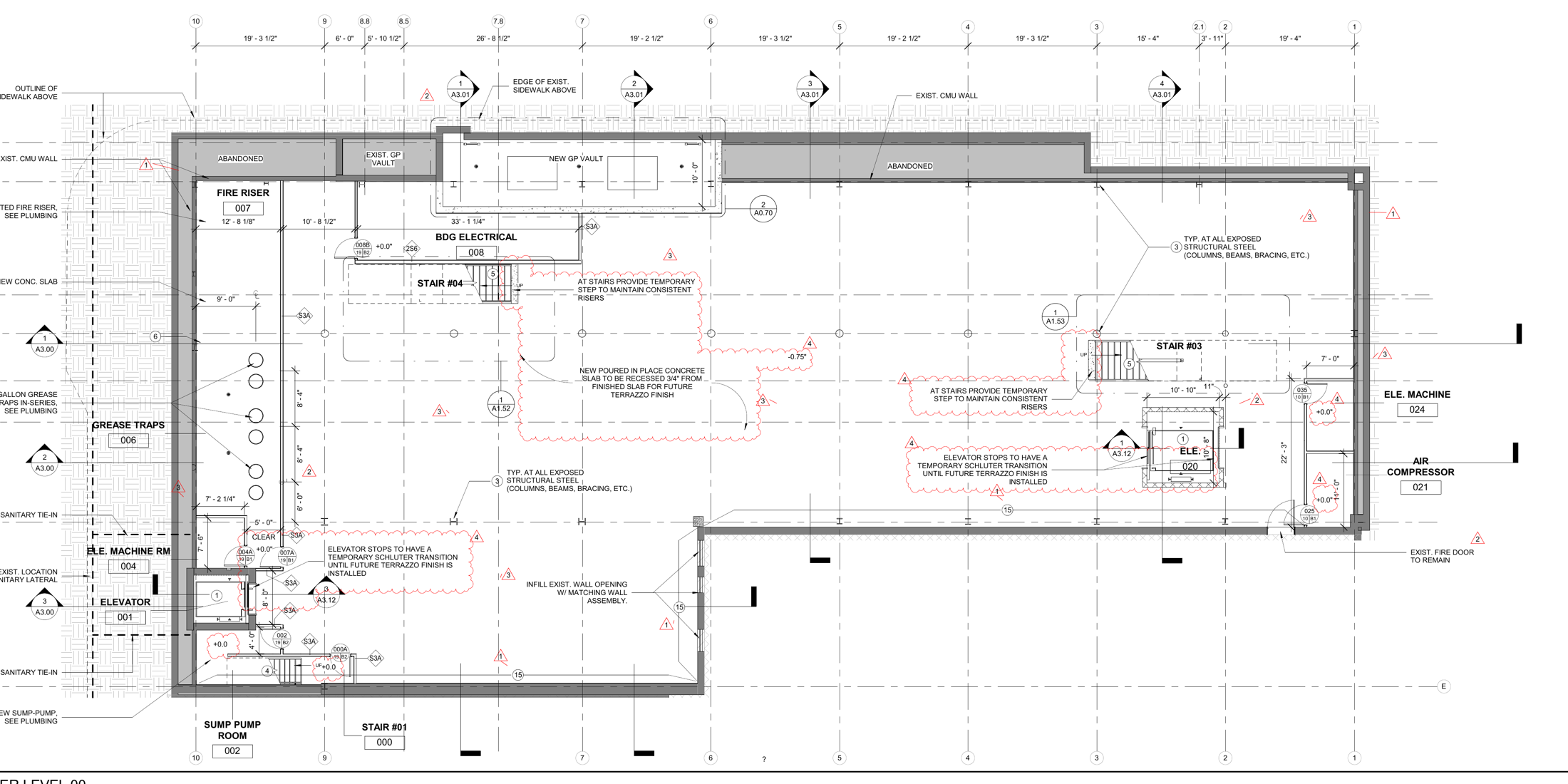
Four exit stairs + two elevator cores already in the permit set — the life-safety skeleton a sleeping use needs
Sprinklered throughout — fire riser room, rated steel treatment and new slab in the current drawings
Tenant stub-ups & floor drains drawn for future restrooms — our bathroom core lands where the plumbing already waits
~19 ft clear-span bays — L-stacks run in library rows between columns; layout study on survey
Lower Level 00, ASD|SKY core-and-shell set (Rev 4, Feb 2026), shared by Bridger Properties · pod capacity ≈104 is a desktop take-off — measured survey and code review are the first workstream.
Phasing
Prove it below, then grow it upstairs
PHASE 1 · THE BASEMENT
104 pods, two formats
L-stack singles and doubles on the lower level — the fastest, lowest-risk build in the building: whitebox in, freestanding stacks, open.
PHASE 2 · MORE FORMATS
The full tier ladder
As trading proves, additional floor(s) take wellness cabins, family quads and recliner day-use — the formats that lift blended ADR at Holborn and Shoreditch.
PHASE 3 · THE DISTRICT
First look across 56 buildings
SoDo holds a portfolio of hard-to-let historic floors. Lume's ask: a right of first offer on expansion space in the building, and first-look conversations across the district as the programme scales.
The sequencing is the risk control: nothing in Phase 2 or 3 is priced into the Phase 1 numbers — each phase is funded only by the performance of the one before it.
The operating system
LumeOS — agentic front of house, agentic back of house
The AI-native operating layer built on Mews PMS — operational leverage that compounds as the portfolio scales
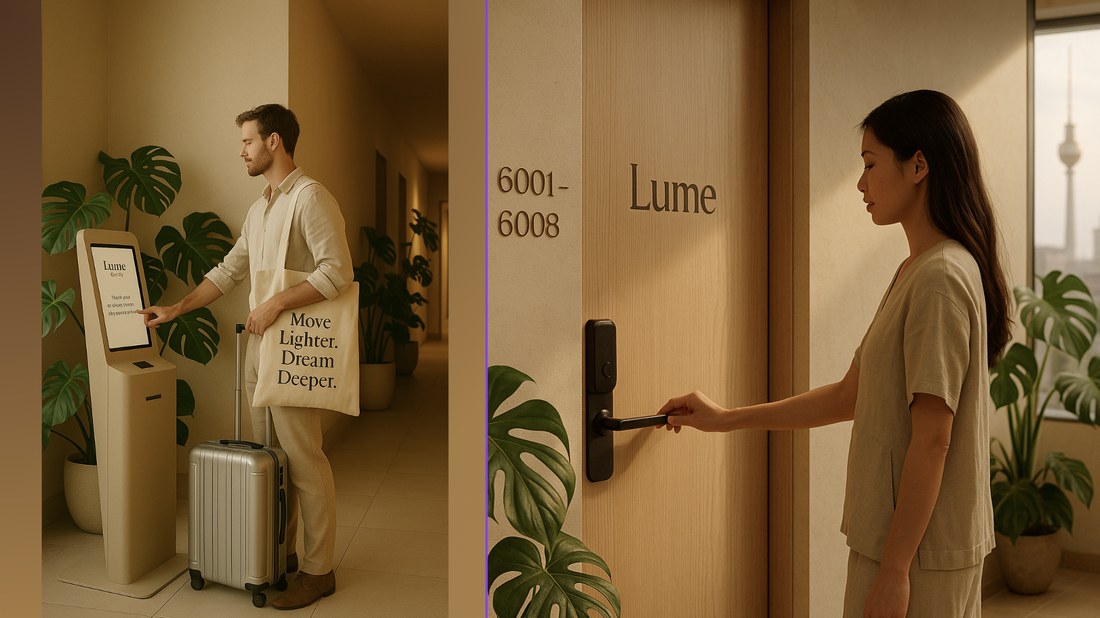
Self check-in kiosks — the front desk that never queues (brand CGI, indicative)
Agentic front of house
Every guest interaction — pre-arrival, check-in, upsells, local recommendations, post-stay — carried by autonomous AI agents in the guest's own language, 24/7, with humans for the moments that matter.
Agentic back of house
Housekeeping scheduling, maintenance tickets, inventory, night audit and reporting run as agent workflows on the PMS — the back office that never sleeps and never scales headcount with pod count.
Dynamic pricing engine
Real-time yield management: agents monitoring OTA competition, the stadium and arena calendars, GSU's academic year and airport disruption — rates re-priced daily.
Why the landlord cares
The participation rides on operating margin — LumeOS is what makes the participation check grow without a single extra employee. The district gets a live occupancy dashboard as part of the deal.
The stack: Claude · Mews · SiteMinder · Looker — third-party marks belong to their owners, shown as tools in the LumeOS stack, not endorsements.
The deal
Straight lease — or a lease that behaves like a JV. Owner's choice.
Option A · Straight lease
- Whitebox delivery by landlord (scope defined overleaf — essentially the current permit set, completed)
- $150K/yr base rent (≈$13.50/sq ft NNN on ≈11,000 sq ft — priced as below-grade leisure/lodging space, not retail), 2.5% annual escalations
- 10-year term + two 5-year options · 6 months' abatement through fit-out
- ICP funds 100% of the ≈$1.26M fit-out · fully demountable pods
- Expansion ROFO on upper-floor space
Option B · The JV-shaped lease
- Same whitebox, same term — base rent $150K/yr plus participation: 25% of pod-floor operating profit above $400K, stepping to 40% above $900K — profit defined open-book at HoTs, with owner audit rights and the live Mews/Looker dashboard
- Modelled landlord income: $150K floor · $249K base case · $409K at the upside grid cell
- Participation starts below 60% occupancy at blended ADR — real income from early trading, no operating downside on the owner
- Live district dashboard + joint event programming on the town square
- First-look framework across the SoDo portfolio as the programme scales
WHO SIGNS & WHAT SECURES IT
A dedicated US SPV, capitalised by ICP for the full fit-out at signing. Security package tabled at HoTs: deposit or letter of credit, insurance schedule (GL, property, liquor for the café), and the insurance-backed lease-guarantee structure we are building in Europe — US equivalent under exploration. European landlord references available on request.
The closer: we fund it, build it and run it; the district gets its overnight population and a growing check. If the format works the way it has everywhere else, the next conversation is about floors, not terms.
Economics
Indicative, benchmarked to the Lume pipeline
| PHASE 1 · BASEMENT |
|---|
| Area | ≈11,000 sq ft (survey to confirm) |
| Pods | 104 — 80 singles · 24 doubles |
| Blended ADR / occupancy (base) | ≈$69 / 74% stabilised |
| Stabilised revenue | ≈$2.1M (incl. 8% ancillary) |
| Fit-out (ICP, 100%) | ≈$1.26M · ≈$12K per pod all-in |
| EBITDA after base rent, pre-participation | ≈$0.80M |
| Landlord income (Option B, base case) | ≈$249K/yr |
Payback on fit-out ≈2 years at stabilised run-rate; ≈3 years allowing for the Year-1 ramp (modelled ~55–60% occupancy, building to 74% by Year 3) and Option-B participation. The 74% is a desktop assumption benchmarked to third-party operators — Bobobox reports 82% on its pod estate — not yet proven by Lume's own trading; the sensitivity grid overleaf is the honest answer to that. All figures indicative, pre-survey.
Where the revenue comes from
| LINE | BASE CASE |
|---|
| Pod revenue (104 × $69 × 74% × 365) | ≈$1.94M |
| Ancillary — lockers, late checkout, vending, partner F&B | ≈$0.16M |
| Staffing, bottom-up: 24/7 host rotation 4.2 FTE + housekeeping 1.5 + GM = ≈6.7 heads, loaded | ≈−$0.42M |
| Utilities, cleaning, supplies, linen | ≈−$0.33M |
| OTA commissions & marketing (11% of pod revenue) | ≈−$0.21M |
| Tech, insurance, admin | ≈−$0.18M |
| Base rent | −$0.15M |
| EBITDA pre-participation | ≈$0.80M |
Supply chain · disclosed in good faith
Named suppliers, landed costs, one ask
| SCOPE | SUPPLIER | NOTES |
|---|
| L-stack capsules — singles & doubles | WeCapsule, Guangzhou | Lume-spec pods; ≈$700–1,400/unit FOB band; consolidated container programme, 4–6 month order-to-install |
| Smart sanitaryware | KELISS | Lume standard fixture set for the bathroom core |
| PMS / guest platform | Mews | The CityHub-proven backbone LumeOS builds on |
| Distribution | SiteMinder | Channel management across OTAs + direct |
| Agentic layer / BI | Claude (Anthropic) · Looker | Agentic front of house & back of house; live dashboards |
| Delivery model | Dual-PM | Atlanta GC/PM for the build · Lume supplier-PM for FF&E and logistics — the model running on the European pipeline |
Capex carries pods at landed cost — FOB + ocean freight + current US duties on China-origin goods + install — at ≈$1,550/pod average. Duty exposure is priced, not wished away; alternate fabrication geographies are scoped as a hedge.
The whitebox we're assuming
The current permit set, completed: new slab · relocated fire riser · rated steel · elevator works · stub-ups and floor drains · building electrical to the floor. Everything inside the box — bathrooms, pods, lounge, tech — is ICP's cost.
The ask that keeps this simple
We're disclosing our supply chain up front, before papers, so you can underwrite us properly — knowing you could source a Guangzhou pod fabricator in an afternoon. The value isn't the phone number; it's the Lume spec, QC protocol and consolidation programme refined across four projects. The ask is the matching courtesy, narrowed to what's genuinely ours: the pod supply relationship and the Lume operating playbook stay with ICP/Lume for capsule-format use in the district — one short mutual letter at HoTs.
Sensitivity
The model, stress-tested cell by cell
EBITDA after base rent, before participation — 104 pods, ancillary and OTA held at model ratios
| OCC \ ADR | $59 | $64 | $69·base | $74 | $79 |
|---|
| 55% | $115K | $216K | $317K | $419K | $520K |
| 65% | $332K | $452K | $571K | $691K | $811K |
| 74% · base | $528K | $664K | $800K | $936K | $1.07M |
| 80% | $658K | $805K | $953K | $1.10M | $1.25M |
| 85% | $767K | $923K | $1.08M | $1.24M | $1.39M |
Every cell in the grid is positive. Breakeven sits at ≈43% occupancy at blended ADR — half the occupancy Bobobox reports on its pod estate.
Three cases, spelled out
| EBITDA | LANDLORD (OPT. B) |
|---|
| Downside · $59 / 55% | $115K | $150K — floor holds |
| Base · $69 / 74% | $800K | $249K |
| Upside · $74 / 85% | $1.24M | $409K |
What the downside really is
In the worst modelled cell the floor still covers its costs and the owner still collects the full base rent — the downside is a slower Phase 2, not a dark floor. The de-gearing order protects the owner first: ICP's return compresses before the base rent is ever touched.
Risk register
The downside is boring — because it's itemised
| RISK | L / I | MITIGATION | OWNER |
|---|
| Life-safety approval for below-grade lodging — the gating risk | M / H | Floor already has 4 exit stairs, 2 cores, sprinklers, rated steel in the permit set; licensing & code pathway led by Zenobia Haynes, our Atlanta licensing lead (introductions at first meeting), with a City of Atlanta pre-submittal conference before HoTs conditions are lifted; Zedwell and the Japanese estate prove the below-grade format at scale | ICP · Z. Haynes |
| Zoning / use classification downtown | L / H | Hotel is an established downtown use; verification of the SPI district permissions is workstream 1, run jointly with the owner's team | ICP + landlord |
| Demand ramp — Five Points under construction to ≈2029 | M / M | Breakeven at ≈43% occupancy; event-calendar demand is construction-independent; direct-booking push (CityHub proves ~50% direct); station completion is late-programme upside | Lume ops |
| Tariffs / supply chain on China-origin pods | M / M | Duties priced into landed cost; consolidated container programme; alternate fabrication geographies scoped; landed pods are ~13% of capex — a 25-point duty swing moves total capex ≈3% | Lume supply |
| Format newness in the US market | M / M | Priced $55 into a $150+ market with no incumbent; soft-open phasing; European playbook + published Bobobox/CityHub/Zedwell precedent; brand marketing rides the district's own press cycle | Lume brand |
| Neighborhood perception of downtown | M / M | 24/7 staffed, secure-access floor; the guest population itself is the district's answer; landlord's $140M programme and town square are the co-investment | Joint |
| Operating cost inflation | M / L | Agentic staffing model holds headcount flat as occupancy grows; utilities on a compact single floor; ancillary revenue offsets | Lume ops |
| Single-floor concentration | L / L | Phase structure means the basement must carry only itself; expansion is optional, never assumed | ICP |
L/I = likelihood / impact. The register, with the sensitivity grid, is maintained live in the data room and re-baselined at survey.
Beyond 86 Broad
The US beachhead of a programme already running
LONDON
Shoreditch
70 pods — opening very soon; rooftop trading since April 2026
MILAN
Largo Richini
58 beds — in fit-out procurement
LONDON · PARIS · MUNICH
In negotiation
121 Holborn, 107 Bd Ney, Munich MoU — the European pipeline
ATLANTA
The US beachhead
Hadi's home market: prove the format at 86 Broad, then grow it across a 56-building district with an aligned owner
86 Broad is designed as the repeatable US deal: whitebox in, freestanding stacks, agentic operations, shared upside. Prove it once beneath Broad Street — then run it together, building by building.
Team
Led from Atlanta, backed by the platform

Hadi Irvani
FOUNDER & MANAGING PARTNER · ATLANTA
Deal lead. Platform strategy, capital, origination — built and scaled a 60-person operating company; lives ten minutes from Broad Street.
MB
Max Bonnie
CO-LEAD · ATLANTA
Co-lead with Hadi on 86 Broad — partnerships and delivery on the ground in Atlanta.

Alexis Janoray
CIO & FOUNDING PARTNER
Underwriting & structuring. 20+ years — VP Development Africa at Accor; Proparco; Outsite Europe.

Aleksander Prus
DIRECTOR OF PRODUCT, LUME
The Lume product system — capsule standards, supplier programme, guest experience across the pipeline.
ICP CENTRAL PLATFORM
Capital, underwriting, approvals, portfolio oversight
LUME CONTROL LAYER
Product, brand, distribution and revenue standards — LumeOS
ATLANTA EXECUTION
Local GC/PM and operations hiring led on the ground by Hadi and Max · licensing & permitting with Zenobia Haynes
Next steps
Three moves to heads of terms
1
Walk the floor
Basement access for a measured survey and layout study — our team mobilises within days
2
Joint code pre-submittal
City of Atlanta pre-submittal conference on below-grade lodging, filed with the owner's team — the answer gates everything
3
Heads of terms
Lease or JV-shaped — owner's election — with the whitebox scope, phasing rights and the non-circumvention letter attached
Indicative timeline: survey + code pre-submittal Sep–Oct 2026 · HoTs Q4 2026 · permits & fit-out H1 2027 · open H2 2027 — each step gated by the one before it.
Hadi Irvani · Founder & Managing Partner · Max Bonnie · Co-Lead, Atlanta
Infill Capital Partners / Lume Hotels · hadi@infillcapitalpartners.com · infillcapitalpartners.com · lumehotels.com
With Shelbi Bodner — Bridger Properties · for SoDo Atlanta / Atlanta Ventures